

Spain’s Average IQ in 2025: is it the highest in Europe?
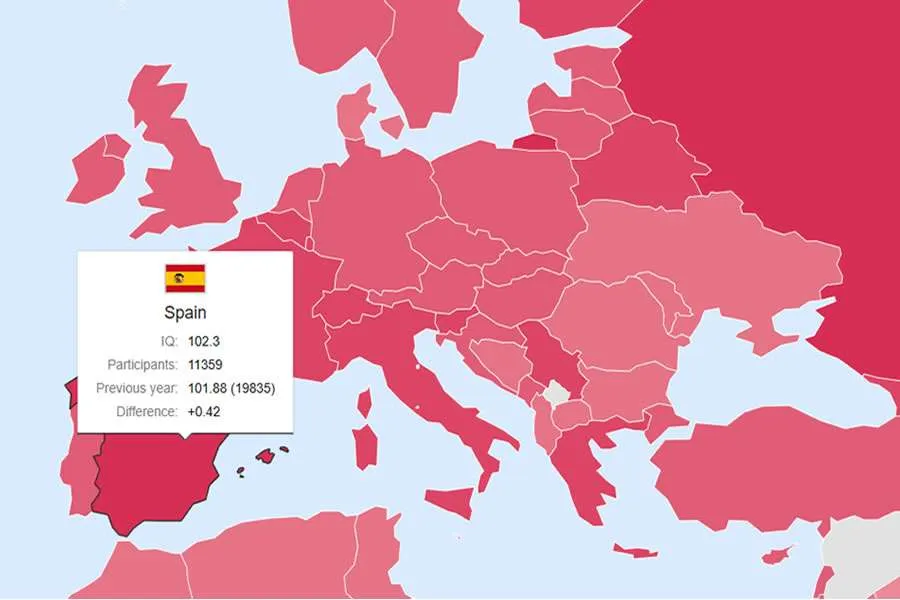
When it comes to international rankings, average IQ by country is one of those indicators that regularly make headlines. According to the latest average IQ by country ranking published in 2025 by the International IQ Test, Spain records an average IQ of 102.3, a score that places it 10th worldwide and, above all, first among the European countries listed around it.
Average IQ in Spain in 2025: The Key Figure
According to the International IQ Test’s ranking of average IQ by country, Spain’s average IQ stands at 102.3. The table also shows 11,359 participants for Spain, compared with a 2024 score of 101.88, representing an increase of +0.42 points.
The test claims standard psychometric normalisation, with a mean of 100 and a standard deviation (SD) of 15, allowing score distributions to be compared on a common scale.
Why Do Some Say “the Highest IQ in Europe”?
A score of 102.3 places Spain ahead of several well-known European countries in the same ranking, such as:
France: 101.42
Italy: 100.84
Switzerland: 100.75
In media coverage, this data is sometimes summarised as “Spain = the highest IQ in Europe,” particularly in comparison with Slovenia (101.96) and France (101.42), which are often cited just behind it.
The IQ Test Behind the Study
The ranking published on January 1, 2025, is presented as being based on 1,352,763 people worldwide who took the same free IQ test in 2024.
The website also explains that it relies on a very large database to refine its scoring algorithm and publishes dedicated pages on methodology and reliability (a distribution close to a Gaussian curve, mean 100, SD 15).
The test is described as being based on Raven-type matrices (abstract reasoning), which are often valued for limiting language effects—even though, in practice, no cognitive measure is ever entirely “culture-neutral.”
What This “Average IQ” Does… and Does Not Say
A national average score derived from an online test can provide an indication of the profile of people who respond, but it should not be interpreted as an “official” measure of an entire country’s population.
The International IQ Test itself acknowledges selection biases: participants are internet users with an interest in this type of test and are therefore not necessarily representative of the whole population (age, education level, motivation, familiarity with testing, and so on).
Another key point is that the site emphasises the use of filters to limit repeat attempts, bots, and suspicious results, but this remains a platform-based methodology.
Should This Be Seen as a “Signal” for Spain?
Even with caution, the 2025 result (102.3) can be read as an interesting signal: among those tested in Spain on this platform, average performance is slightly above the global mean of 100.
This type of ranking is sometimes put into perspective alongside other indicators (PISA results, scientific output, etc.) in mainstream articles. The aim is not to confuse “IQ” with intelligence in the broader sense, but rather to observe how a country performs on a standardised measure of reasoning, while keeping all necessary caveats in mind.
Share: