
Court says developer does not need environmental study to build on Guaza Mountain
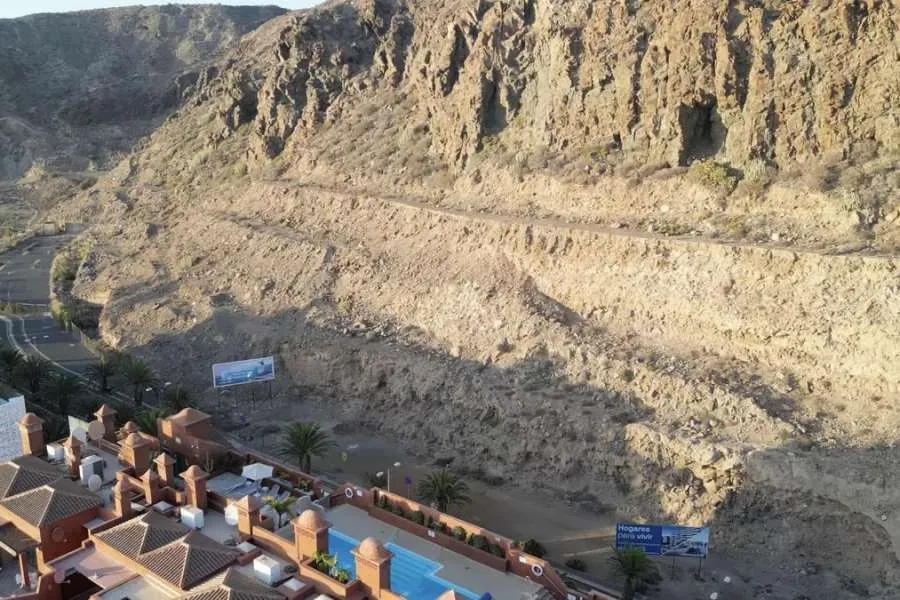
The developer behind one of the housing projects planned on Montaña de Guaza, a legally protected natural mountain in south Tenerife, will not need to carry out an environmental impact assessment to obtain its licence.
This decision was issued by the High Court of Justice of the Canary Islands (TSJC) in a ruling favouring the developer overturning the position of Arona Council.
The council had insisted that an environmental study was essential because the land lies within the EU’s Natura 2000 network and a Special Protection Area for Birds (ZEPA). Despite this, the court confirmed that national legislation allows the assessment to be omitted when the management plan for the protected area already lists the proposed activity as a “permitted use”.
The ruling places the next move firmly in the hands of Arona Council. It must now decide whether to grant the construction licence or appeal to the Supreme Court, for which it has 30 days from the date of notification. So far, the council has not confirmed whether it intends to challenge the judgment.
What the project includes
Metrovacesa plans to build 28 homes, four commercial units, storage rooms, garages, and a shared swimming pool on a 3,200-square-metre plot located on one of the slopes of Guaza Mountain, an area protected for both its environmental and historical value. The site borders the residential-tourist area of Palm-Mar.
A separate nearby project, The Cliff, proposed by the developer Los Menceyes, also remains on hold pending an environmental review.
To date, the only environmental document in the file is a study commissioned by Metrovacesa from Bejeque Medio Ambiente, which states that the project will not have “significant effects” on the environment as long as recommended mitigation measures are followed.
The study identifies the Pimelia canariensis beetle, an endangered species, as the main wildlife at risk. The regional Environment Department authorised protective measures in 2019; these permits have been extended until March 2026.
Court highlights technical inconsistencies
The TSJC notes in its ruling that various technical reports had raised concerns throughout the application process. Some issues were eventually corrected by the developer, yet outstanding deficiencies and contradictions were still being flagged in the most recent documentation.
The court also referenced a meeting in 2023 between council technicians and legal staff, where the team agreed that although the errors in the plans had been fixed, the licence could not be issued without an environmental impact assessment due to what they described as “ambiguous” guidance from the regional Environment Department.
Environmental groups warn of “loss of protection”
The nature group ATAN (Asociación Tinerfeña de Amigos de la Naturaleza) has urged Arona Council to appeal the ruling. The organisation argues that if the judgment becomes final, Montaña de Guaza’s legal protection will be severely weakened, leaving the door open to future developments in an area recognised for its ecological value.
ATAN criticises the council for what it considers a poorly managed legal defence, saying officials failed to provide the technical documentation needed to demonstrate the environmental impact of the planned works. The association warns that the natural monument, already one of the last undeveloped enclaves in the south of the island, could face increasing pressure from speculative developers.
Environmental groups and residents now await Arona’s decision as the controversy around construction on one of south Tenerife’s most distinctive volcanic landmarks continues.
Share: