
Are two-seat ‘mobility scooters’ rented to tourists actually legal in the Canary Islands?
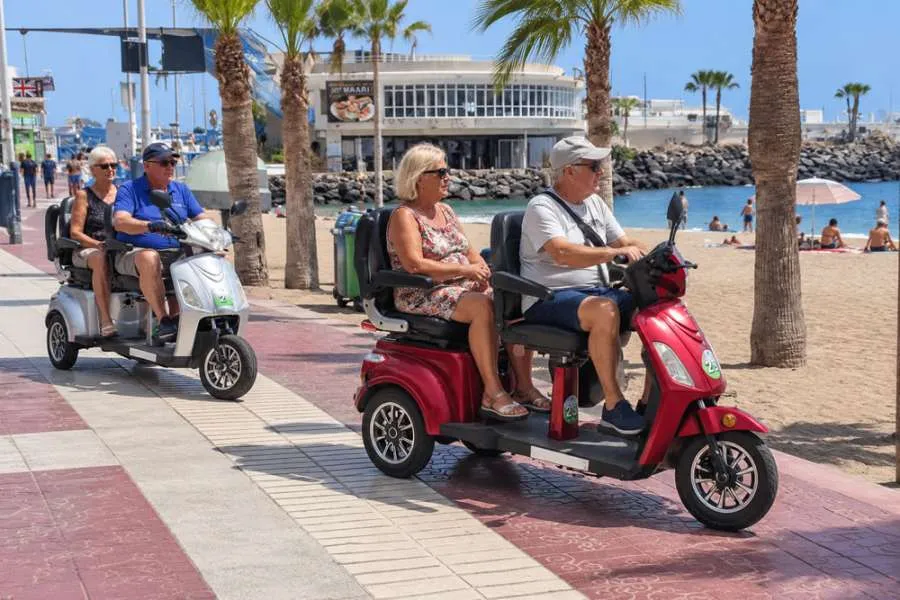
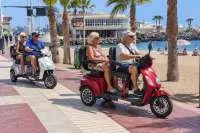
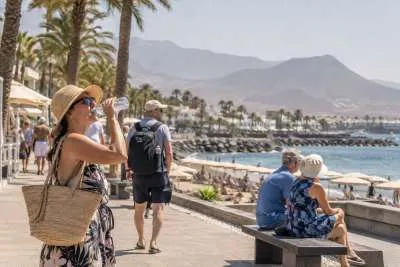
Two-seat electric “mobility scooters” have become a familiar sight in tourist resorts across the Canary Islands, allowing couples to travel together along resort streets and promenades.
They can be hired in Tenerife, Gran Canaria, Lanzarote and Fuerteventura, with some companies advertising double scooters capable of carrying two adults for anything from a few hours to an entire holiday.
However, an examination of Spanish traffic legislation, DGT regulations and municipal enforcement raises an important question: are these vehicles actually legal when rented to ordinary tourists who do not have reduced mobility?
The answer is considerably more complicated than many holidaymakers may realise.
They are not electric scooters under VMP rules
The first important distinction is that a two-person mobility scooter cannot simply be treated as a standard Personal Mobility Vehicle, or VMP, under Spanish law.
The legal definition of a VMP specifically describes a vehicle with one place for one person, powered exclusively by electric motors and generally capable of a design speed between 6km/h and 25km/h.
This means that a two-seat vehicle carrying a driver and passenger cannot qualify as an ordinary VMP simply because it is electrically powered.
That distinction becomes particularly important from 1st October 2026, when Spain introduces substantial changes to its national traffic regulations covering VMP users and other vulnerable road users, also applicable her in the Canary Islands.
Among those changes are a national minimum age of 15 for VMP users, compulsory helmets and increased visibility requirements.
But those new VMP regulations do not automatically turn two-seat mobility scooters into VMPs.
What makes something a mobility vehicle?
Spanish vehicle regulations contain a completely separate definition for vehicles intended for people with reduced mobility.
Crucially, the legislation says such a vehicle must have been specifically designed and constructed, rather than merely adapted, for use by someone with a physical disability or impairment.
That means the purpose and technical classification of the vehicle are important.
A conventional mobility scooter being used by someone with reduced mobility is therefore fundamentally different in law from an electric leisure vehicle being used by two able-bodied tourists simply because it is convenient for travelling around a resort.
The situation becomes particularly interesting with the large tandem or double mobility scooters commonly seen in tourist areas.
Arona has already raised the issue
The strongest evidence that authorities are examining this distinction comes from Arona in Tenerife.
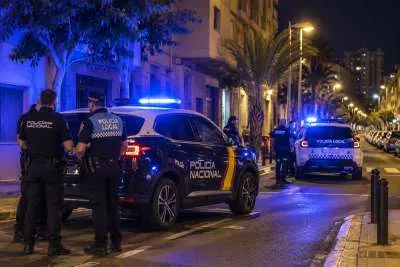
The council revealed last year that its Local Police considered it necessary to examine the regulations governing tandem vehicles intended exclusively for people without disabilities.
More significantly, the council stated that because these vehicles are not considered VMPs, there were questions surrounding whether they could circulate and whether businesses promoting their use could potentially face sanctions.
This is particularly relevant in Los Cristianos, Playa de las Américas and Las Galletas, where mobility scooters and other electric vehicles are commonplace.
Arona's intervention followed extensive enforcement activity involving electric scooters and other vehicles in busy pedestrian and tourist areas.
They are certainly being rented across the islands
This is not simply a Tenerife issue.
Our investigation found two-seat mobility scooters currently being advertised commercially in several Canary Islands tourist destinations.
In south Tenerife, companies advertise three and four-wheel double mobility scooters capable of carrying two adults, including hotel delivery and collection.
However, some Tenerife operators impose restrictions. One company advertising double scooters states explicitly that they are only available to people with disabilities, people with mobility needs or those aged over 65. Another requires customers hiring its double scooter to produce a disabled parking badge as evidence of disability.
That suggests parts of the industry are already conscious of the legal distinction.
In Costa Teguise, Lanzarote, another rental company currently advertises an “E-Mobility Double” for two people.
And in Fuerteventura, a mobility equipment company advertises a two-seat model with a 700W motor, capable of carrying up to 228kg, for hire from €25 per day.
Similar mobility products are available throughout the main Canary Islands tourist resorts.
So can ordinary tourists legally hire one?
This is where the situation becomes less straightforward.
We have found no national legislation stating that all two-seat mobility scooters will suddenly become illegal on 1st October.
Equally, we have found no evidence supporting the proposition that simply describing a two-seat electric vehicle as a “mobility scooter” automatically allows anyone to use it as an ordinary tourist transport vehicle.
Its technical classification, construction, intended purpose and the circumstances in which it is being used all matter.
There is also a major distinction between a genuine mobility aid being used by someone with reduced mobility and a vehicle designed for disabled users being rented as a convenient two-person leisure vehicle to people without mobility requirements.
That distinction is precisely what Arona has already identified as requiring regulatory examination.
Councils also have a say
There is another complication for visitors: local councils regulate significant aspects of how these vehicles and VMPs interact with public spaces.
Rules can therefore differ between municipalities.
Adeje, for example, explicitly states that an ordinary VMP is for one person only and prohibits VMPs from being ridden on pavements and pedestrian areas.
Lanzarote councils have also been tightening enforcement against commercial electric scooter operations. Earlier this year, Yaiza Local Police removed 82 rental VMPs from Playa Blanca after determining that the operator did not have the necessary municipal authorisation.
In July, Tías Local Police removed another 71 rental electric scooters from public areas, predominantly in Puerto del Carmen.
Those cases involved conventional VMP rental operations rather than two-seat disability scooters, but they demonstrate that Canary Islands councils are increasingly scrutinising commercial electric vehicle hire.
What happens on 1st October?
The important conclusion for holidaymakers is that there is currently no evidence of a blanket 1st October ban on two-seat mobility scooters.
The major national traffic changes coming into force that day primarily affect defined categories such as VMPs, motorcycles, mopeds and other vulnerable road users.
However, the increased focus on classification and regulation exposes a much broader issue that already exists.
A two-seat mobility scooter is not an ordinary VMP, and a vehicle does not necessarily acquire the legal privileges associated with disability mobility simply because it is marketed as a “mobility scooter”.
For genuine users with disabilities or reduced mobility, these vehicles provide an important means of independence and accessibility during a holiday.
The unanswered question concerns their use as general tourist transport by people without mobility needs.
With at least one major Canary Islands tourist municipality already questioning the legal position of tandem vehicles and authorities across the islands increasing enforcement of electric mobility regulations, this is an area where rental companies and holidaymakers would be wise to check the precise classification and permitted use of a vehicle before taking it onto public roads or pedestrian areas.
For now, Canarian Weekly has found no basis for saying they will be banned throughout the Canary Islands from 1st October.
But neither should tourists assume that every two-seat electric vehicle available for hire can legally be driven anywhere simply because the rental company calls it a mobility scooter.
Share: