
Green light for major refurbishment of RIU hotel located in Corralejo’s dunes
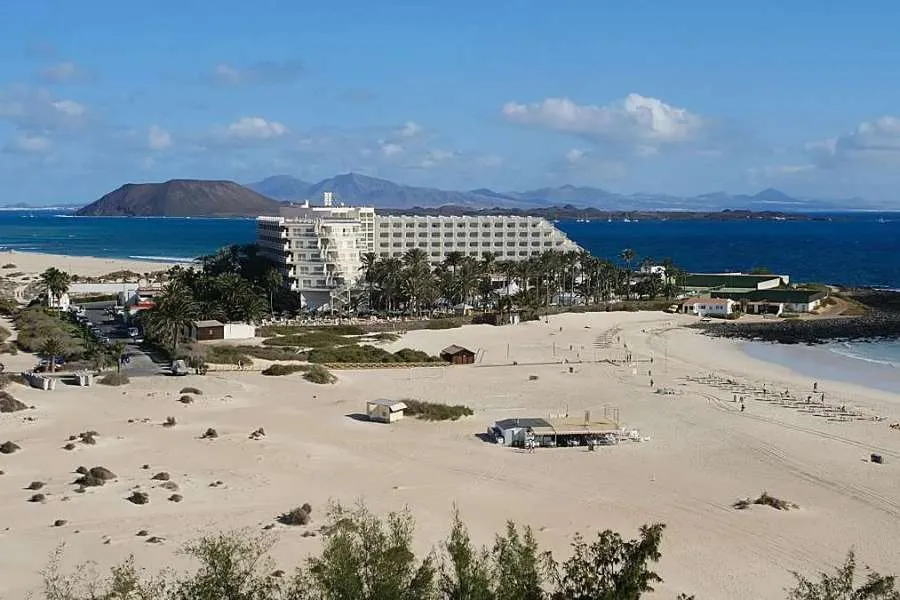
Fuerteventura’s environmental authority has given the go-ahead for a major refurbishment of the RIU Palace Tres Islas, the prominent hotel located among the protected Corralejo Dunes in the north of the island.
Following a simplified environmental impact assessment, the authority concluded that the modernisation project is not expected to have a “significant effect on the environment”, provided that a series of strict environmental conditions are followed during the work.
RIU says the refurbishment is necessary because the building is deteriorating due to its age and constant exposure to salty sea air, and wants the upgraded hotel to become a “benchmark for sustainability”.
However, the project remains sensitive because of the hotel’s location within one of Fuerteventura’s most important protected coastal environments.
Six new rooms, solarium and fitness area
RIU’s plans include more than 20 separate improvements to the Palace Tres Islas.
Among them are six new rooms on the sixth floor, improvements to parking areas, replacement of all lifts and kitchen extraction systems, refurbishment of the reception lobby, a new solarium and fitness area, renovation of one of the swimming pools, and an adapted spa area for guests with reduced mobility.
The hotel group says the work will be concentrated on the existing building, including its interior, communal areas, service facilities, sports areas and swimming pools.
According to the environmental assessment, the project will not increase the authorised volume, height or footprint of the existing hotel.
Hotel surrounded by protected areas
The RIU Palace Tres Islas is in an environmentally sensitive location, surrounded by the Corralejo dune system and habitats protected under the European Union's Natura 2000 network.
These include the Corralejo Special Area of Conservation and the Dunas de Corralejo e Isla de Lobos Special Protection Area for birds. The site also borders the marine conservation area of Sebadales de Corralejo and the Corralejo Natural Park.
Despite its location, the environmental authority concluded that most of the refurbishment will take place within or on existing structures.
As a result, it does not expect significant consumption of geological resources or the occupation of additional natural land.
The visual impact is also expected to be limited and mainly restricted to the construction period.
Officials concluded that, with the required preventative measures, environmental controls and monitoring in place, the project should not significantly affect the integrity of the surrounding Natura 2000 protected areas.
Wildlife must be protected during building work
The environmental assessment does acknowledge that construction could cause “temporary disturbance” to local wildlife.
RIU will therefore be required to minimise noise, dust, artificial lighting and the movement of machinery around the site.
The environmental authority has supported RIU's proposal to temporarily close the hotel while the refurbishment is carried out, reducing the overall activity around the site during construction.
An environmental specialist with experience and knowledge of protected wildlife and plant species must supervise the work.
Protected plants close to the perimeter of the construction area must also be clearly marked and safeguarded, particularly Limonium tuberculatum, a protected species found in the area.
Any invasive or non-native plants that have escaped from the hotel's landscaped areas and are discovered during the works will have to be removed, with measures taken to prevent seeds from spreading.
RIU must also reduce exterior lighting during the Atlantic shearwater season to minimise the risk of disturbing the birds.
Construction work must remain strictly within the authorised area, with no dumping, machinery movements or temporary occupation of surrounding protected land permitted.
If archaeological remains or other items of cultural significance are discovered, work must stop immediately and Fuerteventura's Cultural Heritage Service must be informed.
Environmental groups raised objections
The project has faced objections from several environmental organisations, including concerns about the hotel's location on public coastal land, its impact on the Corralejo Natural Park and Natura 2000 areas, and questions surrounding its planning and concession status.
However, the environmental authority said several of these issues fall outside the scope of the environmental assessment.
An opinion issued by La Oliva Town Council was cited in response to objections concerning planning legality, the hotel's concession, occupation of the maritime-terrestrial public domain and possible changes to the size of the building.
Environmental groups Turcón and Ben Magec also called on the authorities to act “firmly” in accordance with existing legislation and in defence of the public interest.
Their objections additionally referred to the nearby RIU Oliva Beach hotel, calling for its demolition to be completed and for proceedings concerning the Tres Islas concession to continue.
RIU says modernisation is essential
The refurbishment of the Palace Tres Islas is based around four main areas: improving energy efficiency through a new air-conditioning system; strengthening structural safety; modernising the hotel's facilities and accessibility; and improving sustainability through measures including water-saving technology.
RIU argues that the project is essential to guarantee the structural safety and environmental sustainability of the building while improving the quality of the hotel for guests.
The company says the property, which stands at Grandes Playas within the maritime-terrestrial public domain, suffers from “critical technical and energy obsolescence” as well as deterioration caused by its age and long-term exposure to the harsh coastal environment.
With environmental approval now granted, the refurbishment can move forward subject to the conditions imposed to protect the internationally important dune system and wildlife surrounding one of Fuerteventura's best-known hotels.
Share: