
Stargazing on La Palma: Why the skies are the darkest in Europe
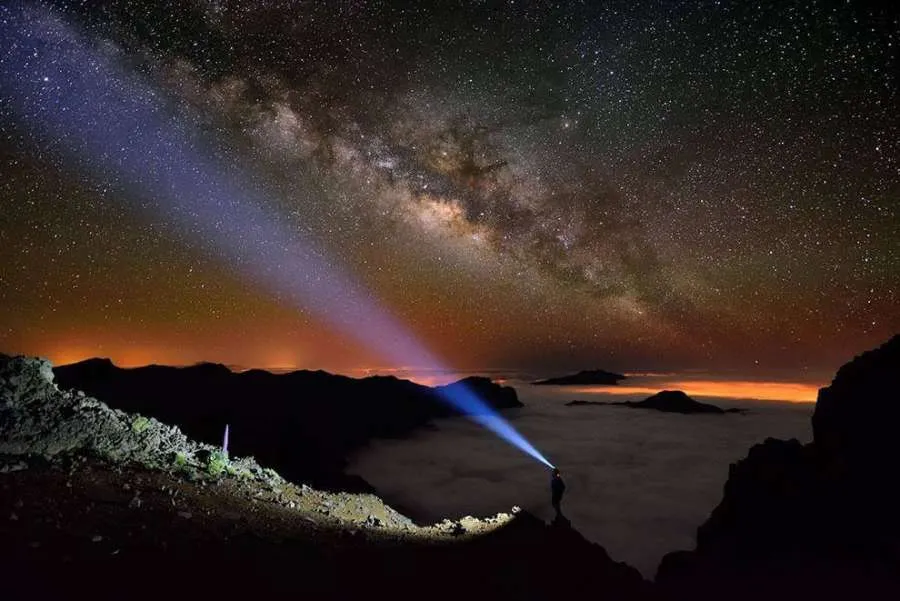
Most travellers pick a Canary Island for the beaches, but La Palma draws those who come for the dark, and it is the only place in Europe where the night sky is protected by its own act of parliament.
The island sits under skies steady enough to host one of the largest optical telescopes on Earth, and clear enough that the Milky Way casts a faint shadow on a moonless night. Here is why the sky above it is so good, what you can see without any equipment, and when to book.
A Sky Protected by Law
Spain passed the Ley del Cielo in 1988, and it remains the reason La Palma's nights look the way they do. The law regulates outdoor lighting across the island, restricts radio interference, and even governs flight paths overhead, all so the observatory on the summit keeps working. Street lamps point down and use lamp types chosen for a clean spectrum, which is why a village at night here glows amber rather than white. Visitors usually notice the difference on the first evening, driving up out of Santa Cruz and finding the stars come out long before the road tops the ridge.
The geography does the rest of the work. Roque de los Muchachos rises to roughly 2,400 metres on the rim of the Caldera de Taburiente, and the trade winds hold a layer of cloud below the summit for much of the year. Astronomers call the result good seeing: the air above that inversion layer is unusually still, so stars twinkle less and images stay sharp. That combination of altitude, steady air and legal protection is rare enough that La Palma became the world's first Starlight Reserve in 2012.
What Sits On Top Of The Mountain
The Roque de los Muchachos Observatory is a working scientific site rather than a visitor attraction, and it is shared by institutions from more than a dozen countries. Its best-known instrument is the Gran Telescopio Canarias, whose segmented primary mirror measures 10.4 metres across and remains among the largest single-aperture optical telescopes anywhere. Guided daytime tours run through the Instituto de Astrofísica de Canarias, and they are worth booking ahead because places are limited and the road up is long. The telescopes themselves are closed at night for obvious reasons, which surprises some visitors.
That matters for planning, because the observatory is not where you go to look at stars. The summit road is often closed or restricted after dark, and the site asks visitors to keep headlights and torches off nearby. The good news is that you do not need to be anywhere near it. Almost any pull-off above the cloud line will do, and several have been laid out specifically for the purpose.
Where To Look, Without A Telescope
The island maintains a set of astronomical viewpoints with orientation panels, and Llano del Jable is the one most visitors reach first. It sits on the volcanic plain below the ridge; the ground is flat and open, and the horizon drops away far enough to show constellations rising rather than only what is overhead. Bring something warm regardless of the season, because the temperature at that altitude bears no relation to the coast. A red torch is the other thing worth packing, since white light resets your night vision and takes twenty minutes to recover.
What shows up on a given night depends mostly on the moon, not the month. In the week around a new moon, the Milky Way runs the length of the sky, and the fainter constellations fill in around it. The band of the zodiac, the twelve constellations the sun appears to pass through over a year, sits high enough here to trace by eye, and it is the same set of shapes that gave astrology its vocabulary. If you find yourself curious about where the planets stood on a particular date, birthcharts.asknebula.com calculates it from the same positions astronomers use.
When To Go, And What To Expect
The clearest stretch runs from late spring through early autumn, when the inversion layer is most reliable, and the summit stays above the cloud. August brings the Perseid meteor shower and the island's darkest skies coincide with it, so accommodation books out early that month. Winter viewing is colder and less predictable, but Orion sits higher here than in northern Europe, and the calderas are quieter. Whichever season you pick, check the moon phase before fixing the dates, because a full moon washes out far more than the weather does.
One practical note for anyone planning around the sky rather than the beach. Guided night tours run from several towns and typically supply telescopes, transport and someone who knows the local horizon, which is worth the money on a first visit. After that, a hire car and a viewpoint are enough. La Palma is small enough to put you somewhere genuinely dark within forty minutes of almost anywhere on the island, and that, more than any single telescope, is what makes it worth the trip.
Share: